 Skip to content

 EN
EN  Deutsch
  Français
  Español
  Italiano
  日本語
日本語  Português


Rhodes · In this guide
Rhodes Guide: Luxury Yacht Charter in Rhodes
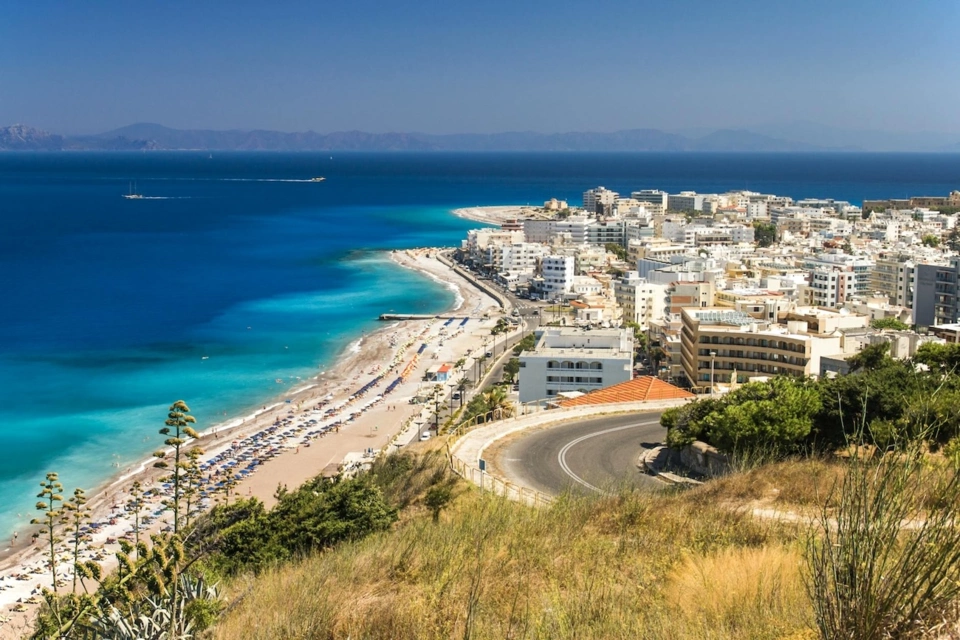
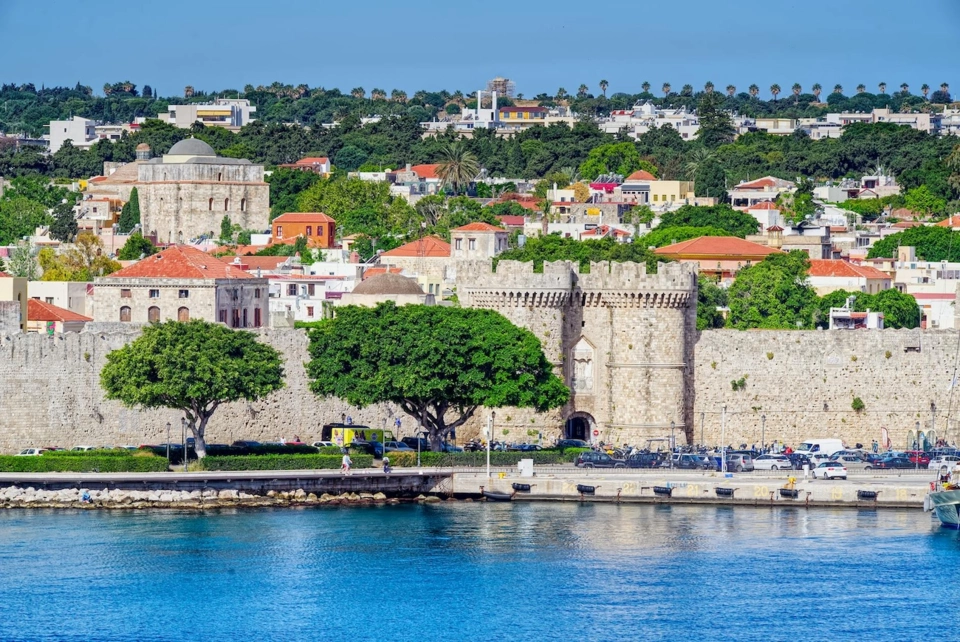
Rhodes is where Greek history meets the crusading knights of medieval Europe. The largest island in the Dodecanese and the ninth largest in the Mediterranean (1,400 square kilometres), Rhodes sits at the far south-eastern corner of the Aegean, just 18 kilometres from the Turkish coast. Its position at the crossroads of east and west has made it a prize for every major Mediterranean power: ancient Greeks, Romans, Byzantines, the Knights of St John, Ottomans and Italians have all left their mark, and the result is an island layered with more visible history per square kilometre than almost anywhere in the Mediterranean. The Medieval Old Town of Rhodes, inscribed as a UNESCO World Heritage Site in 1988, is one of the best-preserved medieval cities in Europe – a walled quarter of cobbled lanes, Gothic arches, Ottoman mosques and the imposing Palace of the Grand Master, all still lived in and very much alive.
For charter guests, Rhodes offers something the Cyclades and Ionian cannot: a base in the Dodecanese, Greece’s south-eastern archipelago, where the sea is warmer, the sunshine more abundant (Rhodes averages over 300 sunny days a year), and the cruising ground includes some of the most characterful small islands in Greece. Symi, just 21 nautical miles south, has a harbour so beautiful it stops you in your tracks – a natural amphitheatre of pastel neoclassical mansions rising from the waterfront. Halki, 24 nautical miles west, is a quiet gem with a single village harbour. And Tilos, a UNESCO Biosphere Reserve, offers wild hillsides carpeted in spring flowers and utterly deserted beaches. Rhodes Marina (382 berths, expanding to 563, handling yachts up to 120 metres) provides world-class superyacht facilities. Start planning your Rhodes charter with Boatcrowd and let our team match you to the perfect yacht and Dodecanese itinerary.
Why Charter a Yacht in Rhodes
A Medieval City on the Water
The Medieval Old Town of Rhodes (UNESCO, inscribed 1988) is one of the longest continuously inhabited medieval towns in Europe. The Knights of St John (the Hospitallers) arrived in 1309 and fortified the city over two centuries, building the Palace of the Grand Master on the foundations of a 7th-century Byzantine citadel and the ancient Temple of Helios. The Street of the Knights (Ippoton) – a remarkably preserved 14th-century avenue lined with the Inns of the various “tongues” (national groupings) of the Order – leads up to the Palace, which was reconstructed by Italian architects in the 1930s and now houses a museum. Walk the 4-kilometre circuit of the city walls (open to visitors) for panoramic views over the harbour, the minarets and the sea.
The Colossus and Mandraki Harbour
Mandraki Harbour, the historic port of Rhodes, is where the Colossus of Rhodes – one of the Seven Wonders of the Ancient World – once stood. The bronze statue of the sun god Helios, roughly 33 metres tall, was completed in 282 BC to celebrate Rhodes’ successful defence against a siege by Demetrius I, and stood for just 54 years before an earthquake brought it down in 226 BC. Today, two bronze deer stand on columns at the harbour entrance where the Colossus may have been. Mandraki is a working harbour, atmospheric and central, though larger yachts will use Rhodes Marina, the island’s modern facility with berths for vessels up to 120 metres.
Lindos: Ancient Acropolis Above the Sea
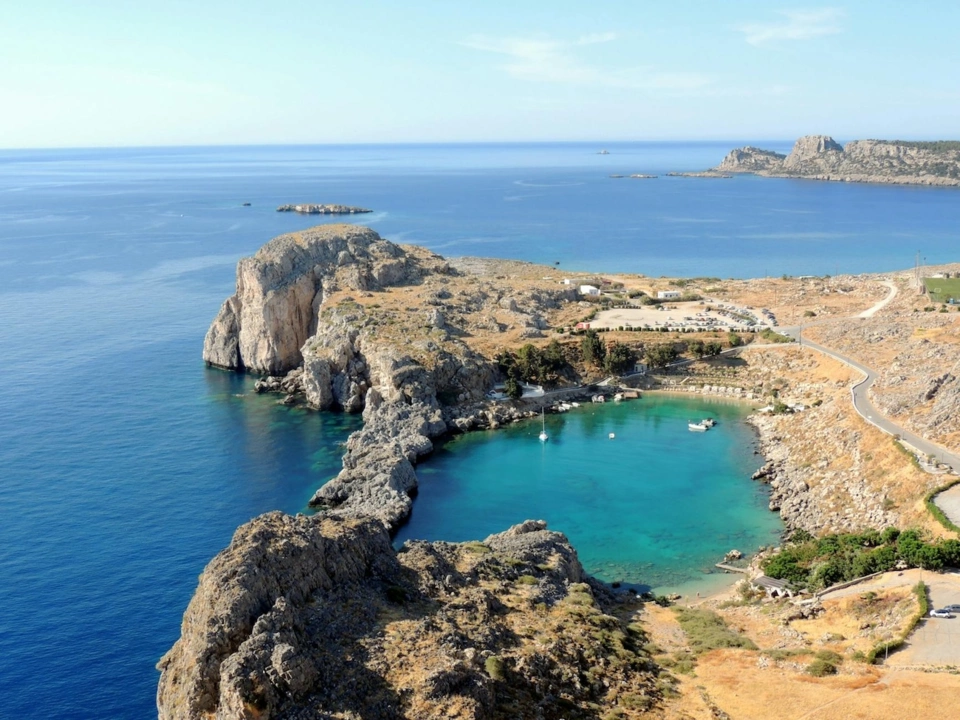
The ancient Acropolis of Lindos, perched on a rocky headland 116 metres above the sea on Rhodes’ eastern coast, is one of the most spectacular archaeological sites in the Aegean. The Temple of Athena Lindia, originally built in the 6th century BC and reconstructed around 300 BC, crowns the summit – Doric columns against the sky, with views stretching across the sea to the Turkish coast. Below, the village of Lindos tumbles down the hillside in a cascade of whitewashed houses, cobbled lanes and sea-captain’s mansions, with St Paul’s Bay – a natural harbour where the Apostle Paul is said to have sheltered during a storm – at its feet. Your yacht anchors in the bay while you walk up to the Acropolis for one of the most rewarding short excursions in Greece.
The Dodecanese Cruising Ground
Rhodes sits at the heart of the Dodecanese, a chain of 15 larger islands and over 150 islets stretching along the Turkish coast. Symi (21 nm south), Halki (24 nm west), Tilos (35–40 nm south-west), and Kos (52 nm north-west) are all within comfortable day-cruise range. The Dodecanese enjoy some of the warmest temperatures and longest sunshine hours in Greece, with sea temperatures reaching 27°C by August. The Meltemi is milder here than in the central Cyclades, making the cruising conditions more comfortable for families and guests who prefer calm seas.
Key Destinations Near Rhodes
• Symi – 21 nm south of Rhodes (about one hour by motor yacht). Symi’s harbour is one of the most beautiful in Greece: a natural amphitheatre of 19th-century neoclassical mansions in pastel colours – ochre, terracotta, lemon, powder blue – rising in tiers from the waterfront. The Panormitis Monastery (dedicated to the Archangel Michael, 18th century) sits on the south-west coast in a bay of its own. Symi has 275 churches in just 25 square miles.
• Lindos – 25 nm south of Rhodes Town along the eastern coast. The Acropolis (Temple of Athena Lindia, 6th century BC), the whitewashed village, St Paul’s Bay, and Lindos Beach. A must-visit on every Rhodes charter.
• Halki – 24 nm west. A quiet island with a single village harbour (Nimborio) of neoclassical pastel houses, crystal-clear water, and a handful of tavernas. Pontamos Beach (10 minutes west) is a stretch of white sand. The pace is slow and the atmosphere is authentic.
• Anthony Quinn Bay – Named after the actor who filmed The Guns of Navarone (1961) on Rhodes and fell in love with this emerald cove on the eastern coast near Faliraki. Excellent snorkelling over rocky reef, with clear water and a dramatic setting.
• Tilos – 35–40 nm south-west. A UNESCO Biosphere Reserve. Wild, unspoilt hillsides carpeted in wildflowers (over 400 species), secluded pebble beaches, traditional stone villages, and virtually no tourists. The Ionian equivalent of time travel.
• Prasonisi – Rhodes’ southern tip, where the Aegean meets the Mediterranean. A narrow sandbar connects the main island to a small rocky islet, with beaches on both sides. World-class windsurfing and kitesurfing in the strong summer winds.
Best Time to Charter in Rhodes
Peak Season: July and August
Hot (30–35°C / 86–95°F) with virtually no rain and sea temperatures of 26–27°C. The Meltemi blows but is milder than in the central Cyclades, keeping conditions manageable. Lindos, Symi and the Old Town are busy with tourists, but arriving by yacht gives you the advantage of early-morning visits. Charter rates peak.
Shoulder Season: May–June and September–October
The ideal months. Warm (22–29°C), calm, and uncrowded. The Old Town and Lindos Acropolis are far more enjoyable without the summer throngs. Sea temperatures are swimmable from May through October. Rhodes’ long season means shoulder-month conditions are often as good as peak summer elsewhere in Greece.
Early and Late Season: April and November
Mild (17–22°C) and pleasant. Rhodes enjoys the longest season in Greece thanks to its south-eastern position. The Old Town, the Valley of the Butterflies (open mid-June through September), and the Acropolis of Lindos are at their best in spring. An excellent time for cultural charters.
Signature Experiences
• Walk the Medieval Walls – The 4-kilometre circuit of Rhodes’ medieval fortifications is open to visitors. Walk along the ramparts built by the Knights of St John, with views over the Old Town’s rooftops, minarets and the harbour below. Allow 90 minutes for the full circuit.
• Lindos Acropolis at Sunrise – Anchor in St Paul’s Bay overnight and walk up to the Acropolis before the tour buses arrive. The Temple of Athena Lindia, the Hellenistic stoa, and the medieval fortifications are all bathed in golden light, with the sea stretching to Turkey on one side and the village tumbling down the hillside on the other.
• Symi Harbour Arrival – The approach to Symi by yacht is one of the most beautiful harbour entrances in Greece. As you round the headland, the amphitheatre of pastel neoclassical houses unfolds before you, reflected in the glassy harbour water. Anchor, take the tender ashore, and climb the Kali Strata staircase (375 steps) to the upper town for panoramic views.
• Valley of the Butterflies – A shaded gorge 26 km from Rhodes Town where thousands of Jersey tiger moths (Euplagia quadripunctaria rhodosensis) gather on the sweetgum trees from mid-June to September. Walk the 45-minute trail through woodland, across wooden bridges and beside flowing streams. A unique natural phenomenon.
• Snorkelling at Anthony Quinn Bay – Named after the actor who fell in love with this emerald cove during the filming of The Guns of Navarone. The rocky reef is alive with grouper, sea bream and octopus. Your crew provides full snorkelling kit and times the visit for morning, when the water is at its clearest.
• Wine Tasting at Emery Winery – Founded in 1923 in the mountain village of Embonas, Emery is one of Greece’s oldest wineries, now in its third generation. Sample local varieties – Athiri, Mandilaria, Muscat – with a guided tour of the cellars. Your crew arranges the excursion as a shore trip from your anchorage.
Yacht Types Available
• Motor Yachts (78’–99’) – Ideal for Rhodes-based charters, with the speed to reach Symi in an hour and Lindos in 90 minutes. All-inclusive crewed charters with water toys and chef. Weekly rates from around $35,000–$55,000.
• Superyachts (100’+) – Rhodes Marina handles vessels up to 120 metres, with a 200-tonne travelift and full technical services. The Dodecanese’s warm waters and sheltered anchorages make it an excellent superyacht cruising ground.
• Luxury Catamarans (55’+) – Stable and spacious for Dodecanese island-hopping. The shallow draft allows access to Symi’s inner harbour and Halki’s tight anchorages. Ideal for families.
Frequently Asked Questions
How do I get to Rhodes?
Rhodes has an international airport (RHO) with direct flights from London, Manchester, Berlin, Stockholm, Amsterdam and other European cities throughout the summer. Year-round connections via Athens (1-hour flight). Transfer from the airport to Rhodes Marina takes about 20 minutes. High-speed ferries also connect Rhodes to Kos, Symi and other Dodecanese islands.
What is the Medieval Old Town like?
The Old Town of Rhodes is one of the best-preserved medieval cities in Europe, surrounded by 4 km of fortified walls built by the Knights of St John from 1309 onward. Inside, you will find the Palace of the Grand Master, the Street of the Knights, Ottoman mosques, Byzantine churches, cobbled lanes and squares alive with restaurants and shops. It is a living city, not a museum – 6,000 people still live within the walls.
Can I visit the Acropolis of Lindos?
Absolutely – it is one of the highlights of a Rhodes charter. Your yacht anchors in St Paul’s Bay or off Lindos Beach, and you walk (or ride a donkey) up to the Acropolis. The Temple of Athena Lindia, the Hellenistic stoa, and the medieval fortifications are all open to visitors. Allow 2–3 hours for the full visit, including the village below.
What local dishes should I try?
Rhodes has a rich culinary tradition. Pitaroudia (chickpea fritters with mint and onion – Rhodes’ national dish, larger and plumper than other Greek versions) are a must-try. Melekouni (honey-sesame bars spiced with cumin and cinnamon, traditionally served at celebrations) is a local speciality dating back centuries. Fresh-caught seafood – especially grilled octopus and red mullet – is exceptional throughout the Dodecanese.
Can I combine Rhodes with other Dodecanese islands?
Yes – Rhodes is the ideal base for Dodecanese exploration. Symi is 21 nm south (one hour), Halki 24 nm west, Tilos 35–40 nm south-west, and Kos 52 nm north-west. A 3- or 4-day charter covers three to four islands comfortably. Longer voyages can extend to Patmos, Leros and Kalymnos in the northern Dodecanese.
Ready to plan your Rhodes charter?
Tell us your dates and party size – we'll match you with the right yacht and crew.
30–45 min by road to Alimos Marina
Every yacht is chartered fully crewed with a professional captain and crew, so no licence or sailing experience is required — you simply step aboard.
Best time to charter Greece
Local knowledgeThe Ionian offers calm, sheltered waters ideal for families, while the Cyclades reward experienced crews when the meltemi blows in high summer.
